





Project Map
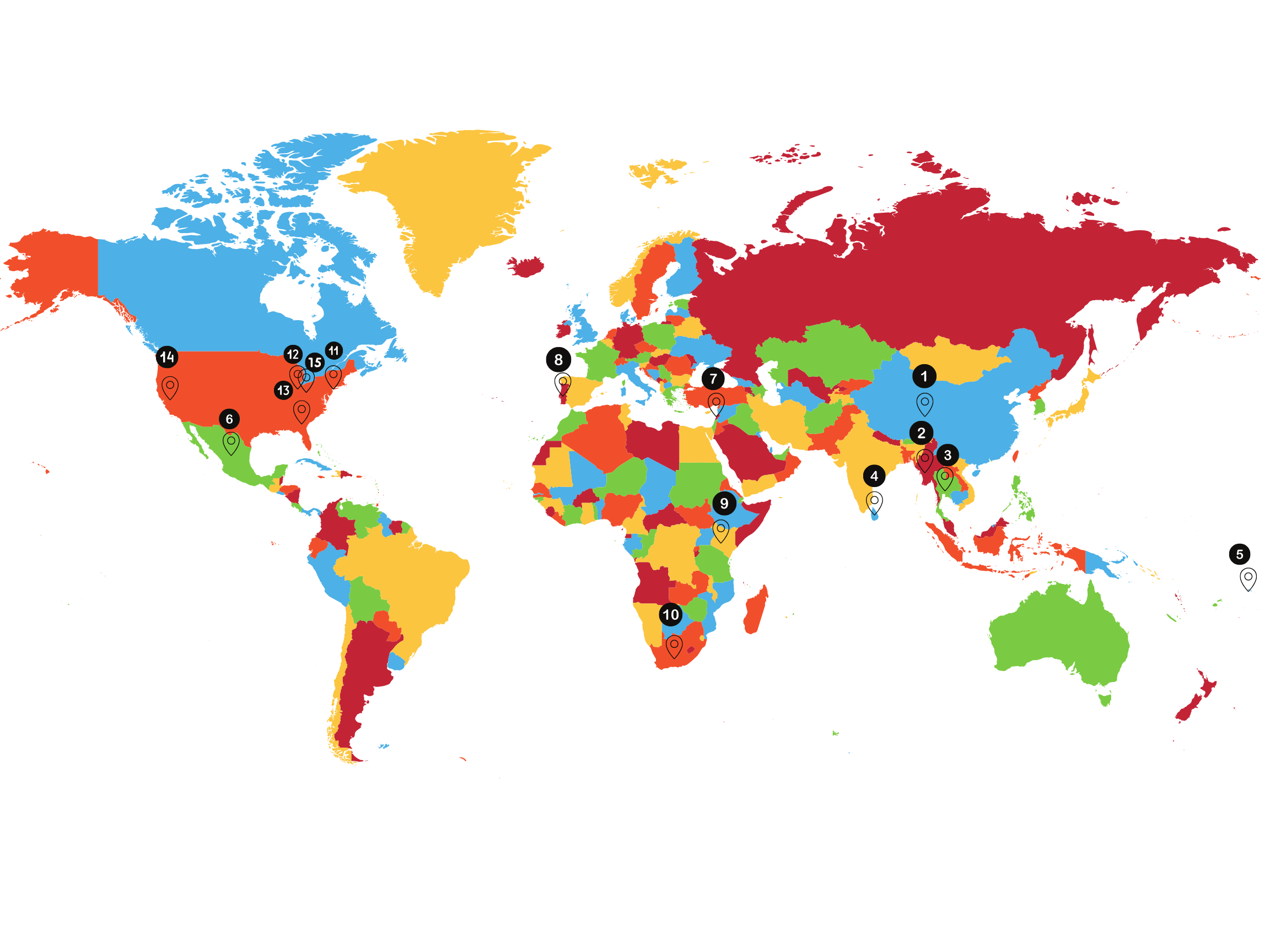
Explore a map of Dr. Ford’s national and global projects, highlighting her research, partnerships, and fieldwork across diverse regions. The map offers a visual snapshot of her ongoing and past initiatives in sexual health, rights, and well-being.
1. China
This study analyzes the prevalence and correlates of orgasm and faking orgasm among Chinese men and women using nationally representative data from the 1999–2000 Chinese Health and Family Life Survey. Using multivariable logistic regression, the authors examine how sexual practices, interactional dynamics, and gendered social expectations are associated with orgasm and faking orgasm among adults aged 20–64. Findings highlight gender inequalities in sexual experience, including lower orgasm rates among women and higher rates of faking orgasm, underscoring the role of social and gender norms in shaping sexual interactions in China.
2. Thailand
This ethnographic study examines how gender- and sexually-diverse male spirit mediums (maa khii) in Northern Thailand achieve social legitimacy and well-being despite broader experiences of stigma and marginalization. Drawing on multi-year qualitative research, the study shows that spirit mediumship enables a ritualized “gender duet” that fosters resilience, familial acceptance, and partial social inclusion within spiritual communities. While this role can be protective for psychosocial and health outcomes, persistent structural barriers remain, particularly in intimate relationships and health equity.
3. Myanmar
This ethnographic study examines the gender identity, gender expression, and sexual orientation of gender-variant male spirit mediums (nat kadaw) in Myanmar. Drawing on field observations and semi-structured interviews conducted between 2010 and 2015, the analysis explores how participants understand their identities in relation to spirit mediumship within a broader context of social change and persistent stigma. Findings show that animistic belief systems can create culturally sanctioned spaces that mitigate stigma and enable gender- and sexual-minority individuals to attain social respect and economic advantage.
4. Sri Lanka
This qualitative study examines the role of community organizations in Sri Lanka’s COVID-19 response amid emerging public health challenges. Drawing on interviews with public health professionals and NGO affiliates, findings show that community organizations provided critical support through fundraising, resource distribution, and health education, and were most effective when they maintained close community ties, collaborated with government, and adopted innovative strategies. The study highlights the importance of community-based organizations as key, yet often overlooked, actors in public health preparedness and response.
5. French Polynesia
This mixed-methods study examines the gender identity, expression, sexual behavior, and health of māhū and raerae in French Polynesia, groups historically recognized as gender diverse within local cultures. Drawing on ethnography, interviews, and survey data from 47 participants across ten islands, the study explores identity development, social acceptance, relationships, and HIV/STI risk. Findings suggest that cultural recognition of a third-gender status functions as a protective factor, offering greater social integration and health-related benefits compared to contexts marked by intense stigma.
6. Mexico
This ethnographic study examines how cultural recognition and valued social roles support resilience among muxe individuals, a third-gender group in Zapotec communities in Oaxaca, Mexico. Drawing on survey and ethnographic data collected across three time points, the study explores gender identity development, family and community acceptance, sexual experiences, and health, including HIV/STI risk. Findings suggest that cultural acceptance functions as a protective factor that promotes well-being and offers important insights for strength-based approaches to transgender health and prevention efforts.
7. Lebanon
The Women Integrated Sexual Health (WISH) Program is a multidisciplinary clinical service that supports sexual health and well-being across the lifespan for women, men, and couples. Through education, counseling, clinical treatment, and rehabilitation, the program addresses a wide range of sexual concerns, including desire, arousal, pain, orgasm, identity, relationship dynamics, and the sexual effects of illness or medical treatment. Using integrated approaches such as sex education, psychotherapy, medical care, and physical therapy, WISH aims to promote sexual health, prevent dysfunction, and help individuals and couples regain satisfying sexual lives.
8. Portugal
The Porto Proclamation on Sexual Health, Rights, and Justice is a global commitment by leading organizations and advocates to advance sexual health as a core component of human rights, dignity, and equity. Grounded in principles of sexual justice, inclusion, evidence, accountability, and person-centered care, the Proclamation emphasizes the integration of sexual pleasure, comprehensive sexuality education, and equitable access to services across the life course. It outlines strategic priorities for coordinated global action, advocacy, and sustainable funding to confront inequality, misinformation, and structural barriers, and to strengthen sexual health, rights, and justice worldwide.
9. Kenya
This qualitative study explores caregiver and community leader perceptions of cervical cancer and HPV vaccination in rural western Kenya to inform vaccine communication and mobilization strategies. Drawing on focus groups and key-informant interviews, findings show limited awareness and high stigma surrounding cervical cancer, alongside strong conditional support for HPV vaccination when endorsed by trusted authorities. The study highlights the need for community-centered education, visible leadership support, and equity-focused communication to ensure successful HPV vaccine introduction.
10. South Africa
This project provides technical guidance on the content, meaning, and application of the World Association of Sexual Health (WAS) Declaration on Sexual Pleasure, established in South Africa, for practitioners and stakeholders working in sexual health and sexual rights. It synthesizes existing evidence to demonstrate the central role of sexual pleasure in health, well-being, and rights, while deconstructing each statement of the Declaration. The project also offers practical guidance, case studies, and advocacy strategies for integrating pleasure into policy, education, and health services across diverse settings.
11. New York
This qualitative study examines narratives of unwanted sex among gay, bisexual, and questioning men in college to address gaps in research on male sexual victimization. Drawing on in-depth accounts, the analysis shows how ambiguous sexual scripts, male power dynamics, heteronormativity, and homophobia shape pressures to engage in unwanted sex. Findings highlight a double bind in which GBQ men feel compelled to perform masculinity and sexual competence while simultaneously fearing loss of control and emasculation.
12. Illinois
This study examines how intersecting gender and sexual minority identities shape sexual assault risk among cisgender bisexual women in the United States. Using data from the Chicago Health and Life Experience of Women study, the analysis identifies associations between sexual assault and experiences of bi-stigma, gender discrimination, earlier identity recognition, and gender presentation. Findings underscore how overlapping sexist and biphobic social forces uniquely heighten bisexual women’s vulnerability to sexual violence.
13. Georgia
This paper frames sexual health as a multidimensional component of overall well-being and highlights persistent sexual health challenges and inequities in the United States. It argues for prioritizing sexual health as a national public health goal to address intersecting issues such as HIV, sexual violence, unintended pregnancy, and structural inequities. The paper presents a logic model and actionable strategies to guide public health practitioners, researchers, and policymakers in advancing sexual health nationwide.
14. California
This study describes the development and testing of YTH StreetConnect, a mobile app designed to help homeless and unstably housed youth and their providers access health and vital services. Using formative research, interviews, focus groups, and usability testing, the project assessed the app’s youth friendliness, functionality, and feasibility. Findings suggest the app is a promising tool for improving service access and coordination, while highlighting areas for enhancement and considerations for future scale-up.
15. Indiana
This study uses data from the 2018 National Survey of Sexual Health and Behavior to examine underlying dimensions of adults’ sexual experiences. Through exploratory factor analysis of descriptive adjectives, the analysis identifies two key dimensions—sexual pleasure and sexual danger—and assesses their associations with sexual health outcomes. Findings show that sexual pleasure is strongly linked to positive sexual experiences and well-being, particularly for women, highlighting the value of multidimensional approaches to studying sex.